A lithium demonstration plant in southeast Saskatchewan is now running in front of an audience.
On October 1, 2026, EMP Metals and its technology partner Saltworks Technologies hosted a delegation at Project Aurora, a continuous-flow lithium refining demonstration facility in the company’s Viewfield Project Area in the Williston Basin. The group included industry leaders, institutional investors and representatives of provincial and federal funding agencies, along with Saskatchewan’s Minister of Energy and Resources, Chris Beaudry, and Daryl Harrison, MLA for Cannington. According to EMP Metals, attendees watched live process runs and reviewed performance data.
The tour followed a September 22 announcement that commissioning was complete and the plant had moved to full-time operations. Taken together, the two steps mark the point where a Saskatchewan brine project stops being a plan on paper and starts producing the operating record that commercial design depends on.
From Construction to an Operating Record
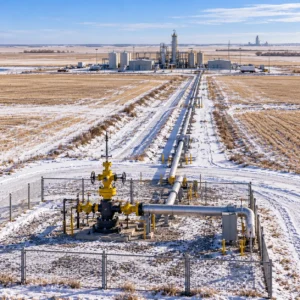
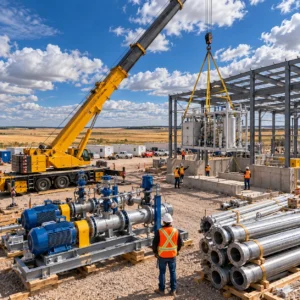
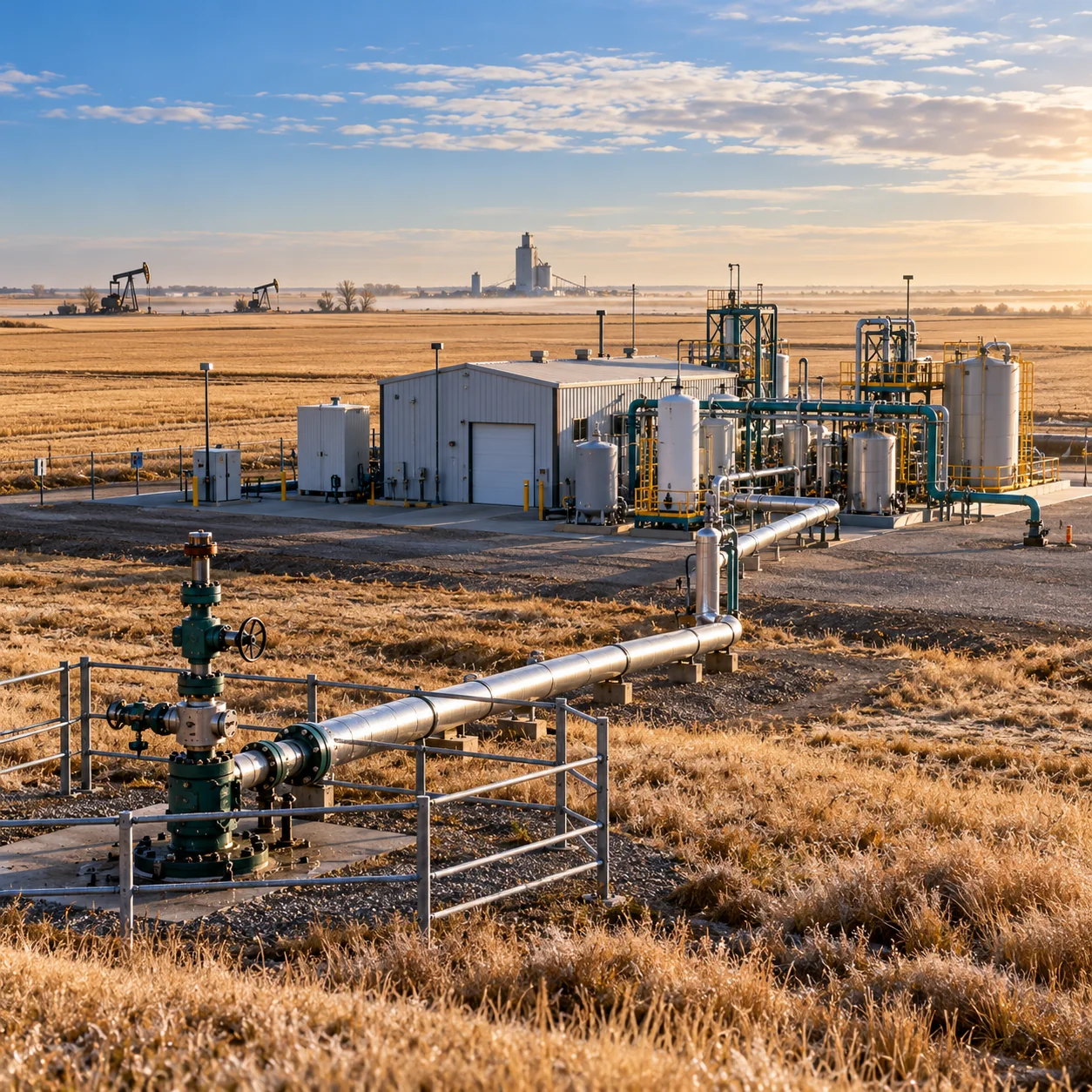
Project Aurora is built to handle 10 cubic metres of raw brine per day, taking it from the wellhead all the way to lithium chemicals. Brine flows directly from a production well into the facility, passes through pre-treatment, direct lithium extraction and concentration, and the spent brine is then injected back into a targeted disposal zone.
Saltworks supplies its Generation-II DLE system for the extraction step, EMP Metals says.
The scale is small by design. The plant’s purpose, as EMP Metals describes it, is to validate process performance, optimise operating parameters and generate the engineering and economic data needed for commercial development. Karl Kottmeier, the company’s chief executive, put it plainly in the September release: “Completing commissioning at Project Aurora marks the transition from construction to an operating demonstration plant.”
He added that “the operating data generated during this phase will be critical as we advance our understanding of the process.”
That is the right emphasis.
DLE developers across North America have learned that laboratory results and short test runs rarely capture what happens when real brine flows continuously through an integrated circuit. Scaling problems tend to appear at the interfaces between pre-treatment, extraction and concentration, and only steady operation on actual feed brine reveals them.
Why Viewfield Brine Gives the Project a Head Start
Not every brine is equally easy to process. EMP Metals points to several features of its Saskatchewan resource that simplify the flowsheet and the field work around it:
- Brine chemistry free of hydrogen sulphide
- No oil-derived organics in the feed
- Shallow, low-cost drilling
- Established regional infrastructure
- More than 205,000 net acres (83,000 hectares) of subsurface dispositions in southern Saskatchewan
The first two points matter more than they might appear. Hydrogen sulphide and residual hydrocarbons add treatment steps, safety systems and cost to any oilfield brine project. A cleaner feed means fewer pre-treatment stages before the brine reaches the sorbent, which in turn can reduce capital cost and operational complexity.
The land position matters too. A large acreage base gives the company room to plan modular expansion across multiple well pads instead of betting everything on a single site.
Saskatchewan Is Putting Policy Behind the Pilot
The minister’s presence at the tour was not ceremonial. Beaudry said Project Aurora is supported by the Saskatchewan Critical Minerals Innovation Incentive and that it “reinforces Saskatchewan’s position as a world-class destination for investment.” Harrison said the facility “highlights the potential of our resources.”
The incentive itself is built for exactly this stage of development. According to the Government of Saskatchewan, it provides credits worth 25 per cent of eligible project costs, capped at C$5 million per project, which corresponds to up to C$20 million in eligible costs. The credits are fully transferable, so companies that are not yet producers or royalty payers can still benefit. Lithium is one of 11 eligible minerals, and for lithium projects, costs dating back to January 1, 2018 can be recognised. The province says it will accept applications until March 31, 2029.
Transferability is the detail developers should watch. Early-stage brine companies have no royalty bill to offset, so a credit they can sell turns a tax measure into usable cash during the years when funding is hardest to secure.
Is that enough to carry a project to production?
No single program is, but it lowers the cost of generating the data that lenders and partners ask for first.
A Modular Path to Commercial Scale
The demonstration plant feeds directly into the next phase. Saltworks is using demonstration-phase data to advance full-scale plant design and cost estimates for a modular commercial refinery capable of producing more than 3,000 tonnes per year of lithium products. EMP Metals plans initial commercial modules targeting 1,500 to 3,000 tonnes of lithium products annually, with expansion to follow.
A modular approach fits the economics of prairie brine. Instead of committing to one large plant sized for a resource that is still being proven, a developer can build a first unit, run it, refine the design and then replicate it. Each module lowers technical risk for the next, and capital can be committed in stages that match the operating evidence.
Saltworks executive Megan Low, vice president of lithium process solutions, described Project Aurora as “a different approach to lithium development,” with the operation designed as an integrated, data-driven system built with commercial scale in mind.
Kottmeier framed the broader stakes in national terms: “Canada’s energy future depends on innovation.”
What the Industry Should Take From Viewfield
Project Aurora joins a growing group of Western Canadian brine developments that are moving from resource claims to operating hardware. For developers, it shows the value of running a complete wellhead-to-chemicals circuit early rather than testing components in isolation. For investors, it offers something more useful than a resource estimate: live process runs on real brine, viewed by the people who will be asked to fund what comes next.
For provincial policymakers, it is an early test of whether targeted, transferable credits can accelerate technology validation in a sector where capital is cautious.
For the Williston Basin, it is another sign that subsurface expertise built for oil can be redirected toward battery materials.
The next milestones are clear: sustained operating data, a full-scale design with cost estimates, and a decision on the first commercial module.
Saskatchewan has its demonstration plant running. The value now lies in the data it produces every day.