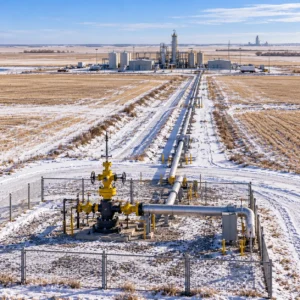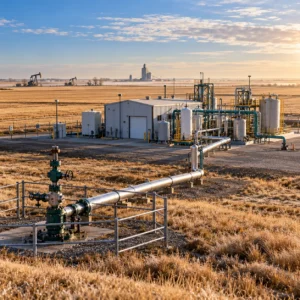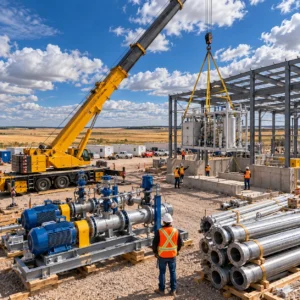

Alberta brine now has a named customer on the other side of the world.
On September 14, E3 Lithium announced a non-binding memorandum of understanding with Epsilon CAM, an Indian developer and manufacturer of lithium iron phosphate (LFP) cathode active materials. The MOU, effective September 1, sets out a framework for the potential supply of up to 5,000 tonnes per year of battery-grade lithium carbonate over a five-year term from E3’s Clearwater Project in central Alberta.
According to E3, that volume represents up to 40% of Clearwater’s proposed Stage 1 production of 12,000 tonnes per year. Days later, on September 17, the company upsized a best efforts equity financing to C$10 million, with net proceeds directed to advancing Clearwater.
An MOU is not a binding contract. It is, however, the kind of commercial signal Canadian direct lithium extraction has been waiting for.
Offtake Is the Missing Piece in Canadian DLE
Canadian brine developers have spent years proving resources and testing extraction technology. E3 has done much of that work. The company reports 21.2 million tonnes of lithium carbonate equivalent in Measured and Indicated resources across Alberta. Its Clearwater Pre-Feasibility Study outlined a 1.13 million tonne LCE reserve at a grade of 75.5 mg/L lithium, with a pre-tax NPV(8%) of US$5.2 billion and a 29.2% IRR, and an after-tax NPV(8%) of US$3.7 billion with a 24.6% IRR.
Numbers like those get a project noticed. They do not get it financed on their own.
Lenders and strategic investors want to know who will buy the product, in what volume and on what terms. For a first-of-its-kind DLE project in Alberta, a credible buyer does as much to reduce risk as another round of testwork.
“Securing long-term offtake contracts is a critical commercial milestone required to advance the Clearwater Project,” said Chris Doornbos, CEO and Chair of E3 Lithium. “This MOU with Epsilon demonstrates a serious interest and draws a clear path from Alberta brine directly into the battery supply chain.”
That framing is right.
An LFP Cathode Maker Is the Right Kind of Buyer
Epsilon is not a trader or an intermediary. It makes LFP cathode active materials, which take battery-grade lithium carbonate as feedstock, the product Clearwater is designed to produce. That is a direct match between what the project makes and what the customer needs.
The buyer also brings technical depth. Established in 2023, Epsilon operates an ISO 9001-certified Cathode Technology Centre in Moosburg, Germany, with a portfolio of 149 patents, a 250-ton commercial demonstration plant and cell testing capabilities. The company says its Gen III LFP is progressing through global customer validations, and it is building a 30,000 tonnes per year cathode materials facility in India, with Phase 1 completion targeted for early 2028.
“The electric mobility growth requires a battery materials supply chain that is resilient, diversified and globally connected,” said Vikram Handa, Managing Director of Epsilon CAM. He described the agreement as an opportunity “to connect upstream lithium resources in Canada with downstream cathode active material production in India.”
A Canada to India Corridor Widens the Market for Alberta Lithium
Much of the discussion about Canadian lithium has centred on supplying North American battery plants. The Epsilon MOU points to a second outlet: new cathode capacity in India, built by a manufacturer that wants a geographically diversified source of lithium chemicals.
For Alberta, that matters. A project with more than one potential market is easier to underwrite than one that depends on a single regional buyer base. It also positions Canadian brine as a supplier to the wider battery industry, rather than a resource reserved for one trade corridor.
Two questions sit behind every Canadian DLE project.
Who buys the lithium?
And will they commit before the plant is built?
E3 now has the beginning of an answer to both.
Capital Moves When Commercial Signals Appear
The financing followed quickly. E3 announced a C$8.5 million best efforts equity financing on September 16, then increased it to C$10 million on September 17. According to the company, the agents agreed to sell 11,115,000 units at C$0.90 per unit, each consisting of one common share and one warrant exercisable at C$1.10 for 36 months after closing.
ATB Cormark Capital Markets and Canaccord Genuity led the syndicate, with an over-allotment option of up to 1,667,250 additional units. Closing was expected on or about September 24, subject to TSX Venture Exchange approval. Net proceeds are earmarked for advancing Clearwater and for general working capital.
The amounts are modest compared with the cost of a commercial plant. The sequence is still telling. A named offtake framework, followed within days by an upsized raise, is how a development company moves from resource story to project story.
What Has to Happen Before the MOU Becomes a Contract
E3 says final volumes and commercial terms will be set as the parties work toward a definitive agreement, and that it expects agreements to be finalized as Clearwater advances toward a final investment decision. That path runs through several milestones developers and investors should track:
- Conversion of the MOU into a definitive offtake with pricing and volumes
- Results from E3’s Demonstration Facility
- Completion of the Clearwater Feasibility Study
- Progress on permitting and regulatory approvals
- Additional buyers for the remaining Stage 1 volume
- Epsilon’s progress toward Phase 1 of its Indian cathode plant by early 2028
None of these steps is unusual. Every commercial lithium project passes through them. What changes with the Epsilon MOU is that Clearwater now enters them with a defined downstream customer in view, and a clear sense of where up to 40% of its first-stage output could go.
For the wider Canadian DLE sector, the lesson is direct. Resource size and project economics open the conversation. Offtake is what carries a project toward a final investment decision.
Clearwater has had the resource and the economics for some time. It now has the start of a customer list.