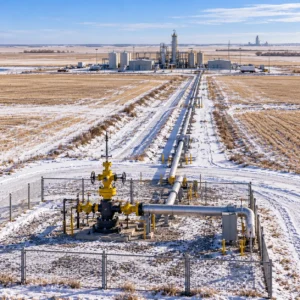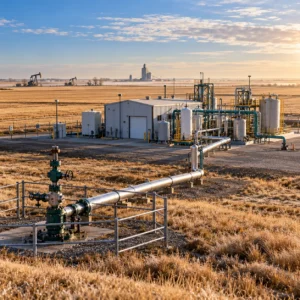
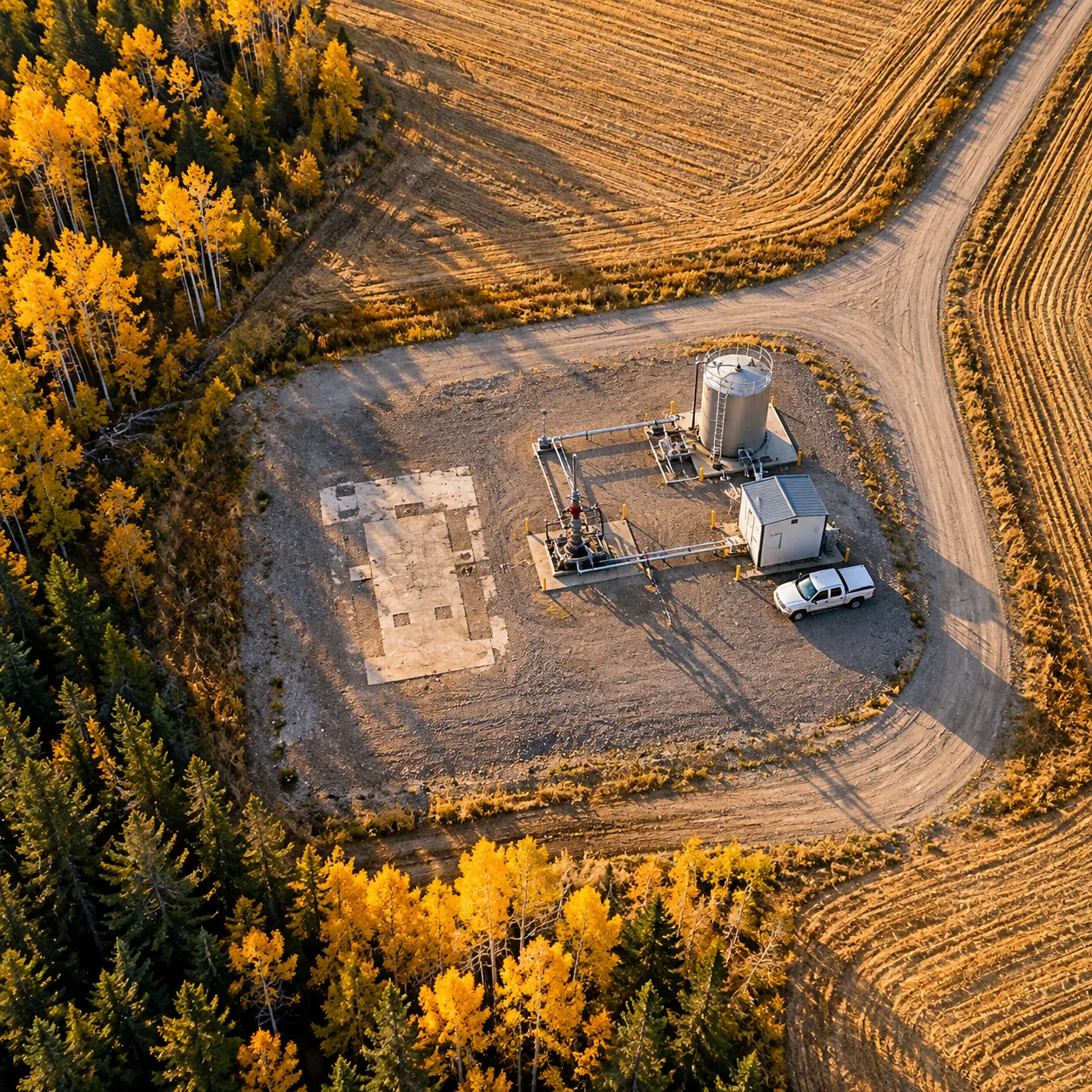
An old oil well in west-central Alberta has a new job.
On September 9, LithiumBank Resources said it had completed the regulatory transfer and conversion of the 10-6 well at its Boardwalk Lithium Brine Project. The well was first drilled and operated as a conventional oil well under Alberta’s Oil and Gas Conservation Act. It is now approved as a dedicated lithium brine production well, licensed under the Mineral Resource Development Act.
On paper, it is a change of licence. In practice, it shows that Alberta’s legacy oilfield can be moved into lithium production through a defined regulatory path, one well at a time.
For developers, investors and service companies following Canadian brine, that matters more than the size of the announcement suggests.
A Licence Change That Proves a Development Model
Boardwalk is 100% owned by LithiumBank and sits within the historic South Sturgeon Lake oilfield. The 10-6 well produces lithium-bearing brine from the Devonian Leduc formation, one of the best-known reservoirs in the Western Canada Sedimentary Basin.
The well is not new to the project. According to the company, it has already served as a key sampling point, supplying the bulk brine used for long-cycle direct lithium extraction testing, process optimisation and downstream conversion to battery-grade lithium carbonate. The reclassification turns a sampling asset into a production asset.
Chief executive Rob Shewchuk called the re-designation “an important operational milestone for LithiumBank,” adding that it validates the company’s brownfield development strategy.
That second point is the real story.
Brownfield Wells Change the Economics of Dilute Brine
Alberta brines are not Atacama brines. LithiumBank reports a measured and indicated resource at Boardwalk of 5.195 million tonnes of lithium carbonate equivalent at 81.6 milligrams of lithium per litre. At that grade, a commercial operation has to move very large volumes of fluid, which means wells, pipelines, power and surface facilities are a large share of the capital bill.
That is where the oilfield helps. LithiumBank says converting legacy oil and gas assets reduces upfront capital spending, lowers surface disturbance and shortens development timelines. South Sturgeon Lake already has roads, power and decades of subsurface data. A new lithium developer drilling greenfield wells would have to build or buy all of that.
Every well that does not have to be drilled is capital that does not have to be raised.
For a junior developer financing a first commercial project, that difference can decide whether a project reaches a final investment decision or stays in study.
The Pieces of Boardwalk Are Starting to Line Up
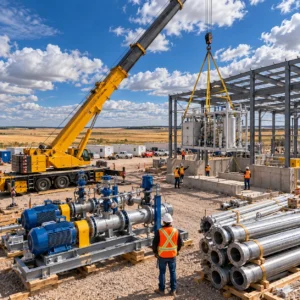
The well conversion is the latest in a series of steps that point in the same direction. In December 2025, LithiumBank signed a development agreement with a major energy services and technology supplier, since identified by the company as SLB, that includes binding licensing terms for modular DLE technology. According to that announcement, the initial phase envisages two DLE modules capable of producing up to 10,000 tonnes per year of lithium carbonate equivalent, with further expansion in 5,000 tonne increments, and project execution targeted for 2027.
In July 2026, the company signed a non-binding letter of intent for a two-year option to acquire existing wells, pipelines, surface leases and easements for Boardwalk. The option carries a C$1 million signing payment and a C$2.5 million exercise price, split between cash and shares, and remains subject to TSX Venture Exchange and Alberta Energy Regulator approval.
Put together, the strategy is consistent: license proven extraction technology from an oilfield services major, build in modules, and reuse oilfield infrastructure wherever the regulator allows. The 10-6 conversion shows that last part working in practice.
What Alberta’s Oilfield Operators Should Take From It
LithiumBank holds 1,240,140 acres of brownfield brine-hosted mineral licences across Alberta and Saskatchewan. It is not alone in seeing the basin’s suspended and producing wells as a second resource. The difference now is a completed precedent for moving a well from the oil and gas regime to the mineral regime.
For operators and developers weighing similar conversions, the practical questions are clear:
- Well integrity, completion history and suitability for sustained brine production
- Time and process required to transfer licences between regulatory regimes
- Access to existing pipelines, roads and grid power
- Rights to surface leases and easements around the wellsite
- Bulk brine availability for long-cycle DLE testing on real feed chemistry
- Disposal or reinjection capacity for lithium-depleted brine
Each of these turns a theoretical brownfield advantage into an actual one. Projects that can answer them early will look much stronger to lenders and offtakers than projects relying on resource size alone.
The Next Test Is Engineering, Not Geology
Boardwalk’s resource is defined and its technology partner is in place. Now it has a licensed production well. The next milestones are the engineering studies under the SLB agreement and the decision on project execution that the company has targeted for 2027.
Those studies will need to show that modular DLE can perform consistently on Leduc brine at commercial flow rates, and that the cost savings from reused infrastructure hold up in a full capital estimate. Those are demanding tests. They are also the right ones for a Canadian brine sector that has spent years proving resources and is now being asked to prove projects.
Alberta already built the wells. Boardwalk is showing they can be licensed to produce a second resource.