Alberta’s lithium story is moving from the lab bench to the wellhead.
On October 22, 2026, E3 Lithium said Phase 2 of its Clearwater demonstration facility in Mountain View County is nearing completion. The program has now moved more than 60,000 cubic metres of brine and, according to the company, confirmed sustained production from the Leduc reservoir. In the same release, E3 laid out the five business drivers it needs to clear before the project is ready for a final investment decision.
That combination matters. Western Canada has spent years proving that its oilfield brines hold lithium. The harder question has always been whether a reservoir can deliver that brine steadily, at commercial rates, for decades. Phase 2 was built to answer exactly that.
Phase 2 Was a Reservoir Test, Not a Chemistry Test
Most of the attention in direct lithium extraction goes to the sorbents, columns and refining steps. Phase 2 deliberately looked underneath them.
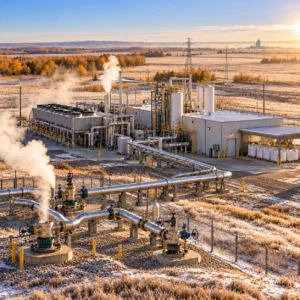
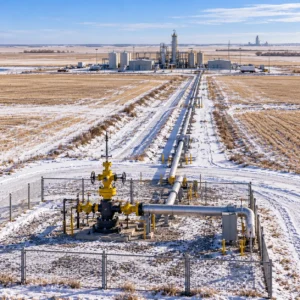
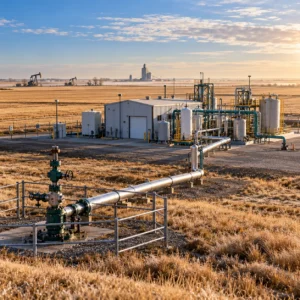
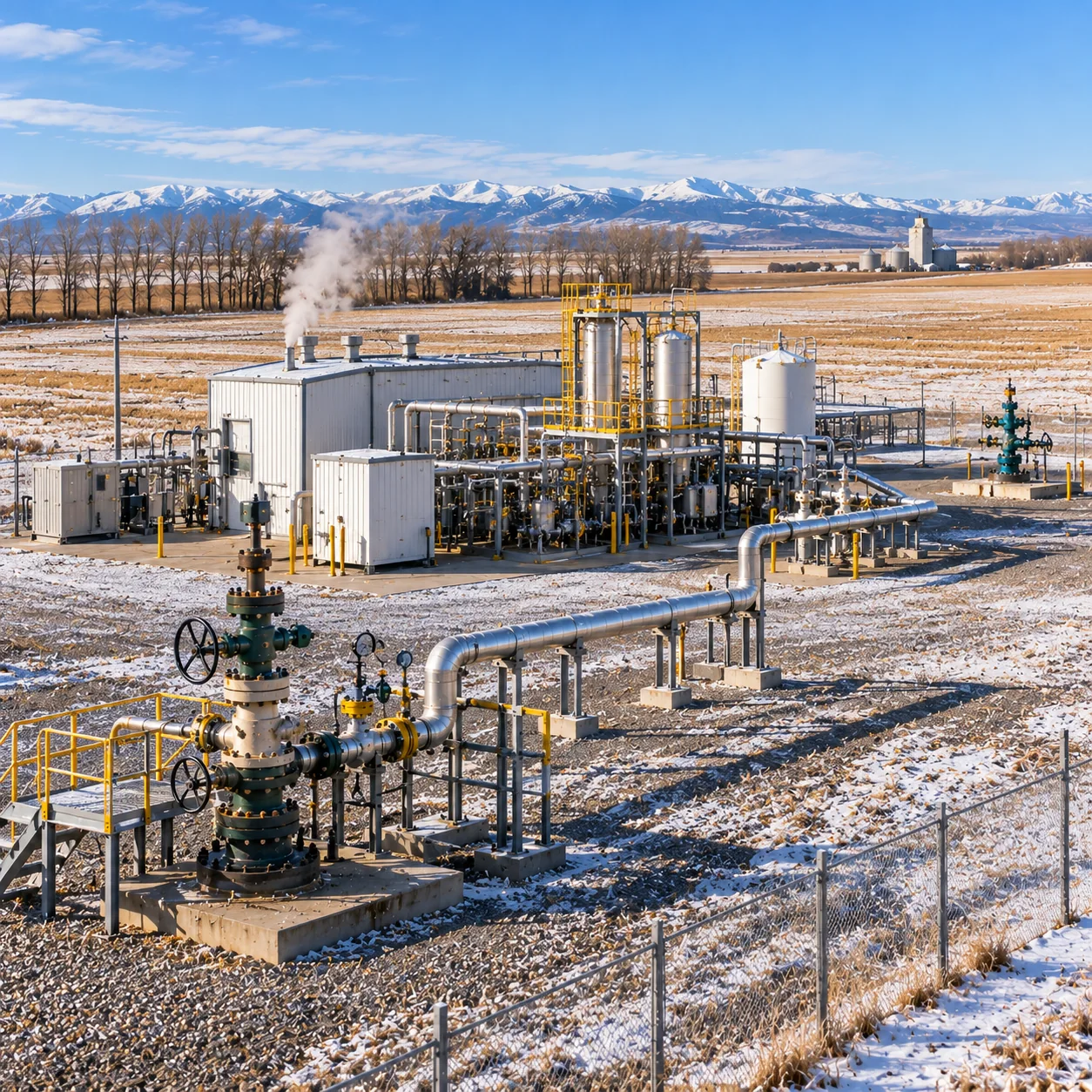
E3 drilled and operated one full-size producer well and one injector well, both designed to the specifications of its Pre-Feasibility Study. The goal was to test the Leduc reservoir under the same conditions a commercial wellfield would face and to collect the data the Feasibility Study needs. The company reports that brine chemistry was consistent across the broader resource and that the program produced gas and water data to support the design of the commercial facility.
That is unglamorous work.
It is also the work lenders care about most. A DLE flowsheet can be tuned. A reservoir that underdelivers cannot. By running full-size wells rather than small test bores, E3 is replacing assumptions about flow and chemistry with measured operating history.
Five Drivers Define What Shovel Ready Means
The October release is useful because it turns a vague goal into a checklist. E3 says it will reach shovel-ready status by working through five business drivers:
- Demonstrating commercial-scale DLE operations
- Outlining an economically sound project at a Class III cost estimate
- Securing commercial permits
- Executing binding offtake agreements
- Completing project financing ahead of a final investment decision
Each item maps to a specific risk an investor would otherwise price in. Technology risk, cost risk, regulatory risk, market risk and funding risk are all named and assigned a path. That kind of framing is still rare among early-stage brine developers, and it gives partners a clearer way to measure progress.
Chief executive Chris Doornbos put the philosophy plainly: “E3 is designing the Clearwater Project exactly as we intend to build it.” He added that the approach “reduces construction risk, protects capital” for the company and its backers.
Phase 3 Brings the Columns Back and Adds Commercial Scale
Once Phase 2 wraps up, E3 plans to restart its 30-column DLE system in the fourth quarter of 2026 to produce battery-grade lithium carbonate. That system has already done this once. In January 2026, the company reported delivering battery-grade lithium carbonate from its demonstration program to global partners and offtakers.
The bigger step comes in 2027. E3 says it is finalizing the design and procurement of a commercial-scale DLE column scheduled to begin operating that year. Its stated purpose is to generate operating data for project financiers, strategic partners and offtakers.
This is the gap the whole sector is trying to close.
Pilot columns prove selectivity. A commercial-size column proves uptime, sorbent life, reagent consumption and maintenance cycles at the scale that will actually be financed. Data from a unit that matches the final design carries far more weight with a bank than results scaled up from a smaller rig.
Federal Money and Provincial Permits Are Already in Motion
Clearwater is not waiting on paperwork. E3 says its Directive 056 facility licence and EPEA applications for the Central Processing Facility were submitted to the Alberta Energy Regulator between December 2025 and January 2026. The facility is described as scalable to 30,000 tonnes per year, while Stage 1 targets about 12,000 tonnes per year of battery-grade lithium carbonate.
Funding is lined up for the next stretch as well. Up to $36.5 million in non-repayable support from Natural Resources Canada’s Global Partnerships Initiative backs Phase 3 and front-end engineering design. E3 also closed an upsized equity financing of about $11.5 million in gross proceeds in September 2026.
On the market side, the company holds non-binding memoranda of understanding with Epsilon CAM in India, Tees Valley Lithium in the United Kingdom and Axens in France. Converting those into binding contracts is one of the five drivers, and it is the one most closely tied to project debt.
A Canadian Cathode Link Adds Downstream Depth
E3’s lithium is also finding a role in domestic battery research. On November 2, 2026, the company said it had joined a collaborative research project with the National Research Council of Canada and POSCO America Corporation to develop a Canadian-made lithium-manganese-rich cathode. E3 will be the exclusive supplier of lithium carbonate to the project, which receives CA$98,798 from the NRC’s Critical Battery Materials Initiative.
The sum is small. The signal is not. A Korean battery materials group validating cathode chemistry built on Alberta lithium carbonate is the kind of qualification step that future offtake talks lean on.
What Clearwater Means for Alberta Brine Developers
Alberta’s DLE sector has plenty of resource. What it has lacked is a project with long-run reservoir data, regulatory filings in hand and a defined route to a financing decision. Clearwater now has all three under way, and the order in which E3 is tackling them offers a template others can follow.
Can Leduc brine flow at commercial rates for the long term?
Can a full-size column hold its performance through a full operating year?
Phase 2 has started answering the first question. The 2027 commercial column is built to answer the second. Together they will tell the market whether Canadian oilfield brine can carry project finance on its own merits.
Clearwater has proven the brine is there. Now it is proving the reservoir can keep delivering it.